Pokémon to Level Up First in Pokémon GO
Who doesn't want to level up quickly in Pokémon GO? Nobody. Because of this, some trainers keep wasting Stardust on a Pokémon they'll only bench a week later. Stardust is a limited, valuable resource, but not everyone knows how to utilize it correctly. The very first investments you make in Pokémon GO determine whether you make it or break it. You need to invest smart, and this article will teach you the order of acquiring your resources.
First, Know What You Are Building For

When we say “level up,” we often mean either of the two things: powering up individual Pokémon for raids and battles, or leveling your trainer account for better rewards and higher CP caps. Whichever of these may be your goal, spreading your money across the types you use most in fights is always more strategic instead of maxing one legendary.
Megas (e.g., Mega Rayquaza), Primals (e.g., Primal Groudon and Primal Kyogre), and fuse legendaries are nice to have because they're ridiculously strong, but they are quite demanding to farm and manage. Mega evolving demands Mega Energy earned from raids or Community Days, and the legendaries themselves only show up in raids once in a blue moon. It's better to have consistent Pokémon you can rely on that only require common candy, and are super effective against entire categories of raid bosses.
The Best Attackers to Power Up First
The best way to go about raids is to prioritize type coverage and leave no room for weaknesses. The top seven budget attackers below are what we personally recommend. They're cheap to feed, easy to catch, and stay relevant in the current meta regardless of patch updates.
Pokémon | Best Moveset | Covers | Why It Goes First |
Metagross | Bullet Punch + Meteor Mash | Steel, hits Fairy and Ice | Elite Steel DPS, top tier Master League regular |
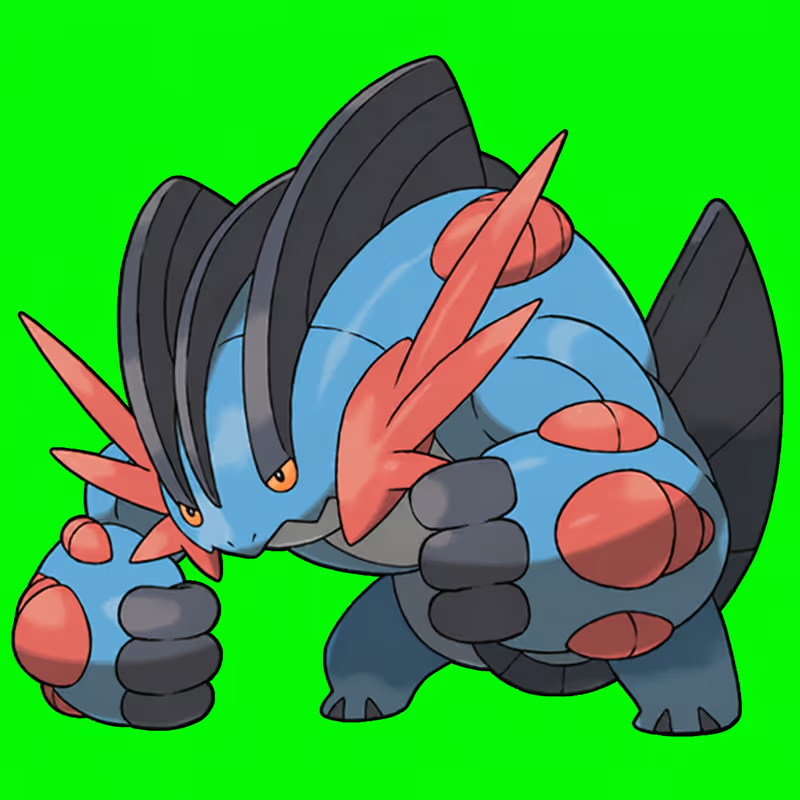
Swampert | Mud Shot + Hydro Cannon | Water, hits Fire and Rock | A single weakness and huge PvP value |
Machamp | Counter + Dynamic Punch | Fighting, hits Normal and Dark | Fighting-type moves outclass other options against tanky gym defenders like Blissey and Snorlax |
Rhyperior | Smack Down + Rock Wrecker | Rock and Ground, hits Flying | Best budget Rock attacker in the game, with strong TDO that holds up against Ground types |
Gengar | Shadow Claw + Shadow Ball | Ghost and Poison, hits Psychic | Ghost-type glass cannon with terrifying burst damage |
Garchomp | Dragon Tail + Outrage | Dragon and Ground, hits Dragon | Best overall dragon-type you can build without legendaries |
Mamoswine | Powder Snow + Avalanche | Ice, hits Dragon and Flying | Melts the entire dragon-type meta and flying-type threats on a budget |
Once you've built your seven core attackers with the movesets listed above, you can confidently take on any raid now that you can counter the raid boss's weaknesses. Also, the Shadow versions of Machamp and Metagross hit about 20 percent harder, so spending stardust on them is a worthy investment.
Just steer clear of purifying them to clear Frustration, or you can kiss that 20 percent bonus goodbye. It's better to wait for a Team GO Rocket Takeover event, where a Charged TM can remove the Frustration for free, allowing you to keep the 20-percent boost. If there's any legendary that's worth the dust, it's Psystrike, a signature move that makes it one of the best psychic-type attackers in the game. Its Mega Evolution and Shadow forms are top-tier as well, and can hold up very well in Master League.
You might also like
Metagross, Swampert, and Why Versatility Wins
My choices for the top two priority attackers are easily Metagross and Swampert. Metagross combats the Fairy and Dragon types that dominate the Master League, and its Steel typing resists eleven types, making it extremely valuable for staying in the fight long enough to actually inflict damage.
Swampert, on the other hand, makes for a great reliable water-type attacker as its only weakness is Grass. Its Hydro Cannon positions it as a staple across Great and Ultra League.
Gengar is also worth looking into. Mega Gengar ranks among the top attackers on both the Ghost and Poison types charts, just barely behind Mega Mewtwo Y and Eternatus, respectively. A sneeze from a raid boss may be its weakness, but the burst totally makes up for the relobby. Machamp rounds out your roster of useful types by covering fighting matchups, and it's cheap enough to build twice.
The same goes for Lucario, who might not be part of the seven listed in the table, but together with Dragonite, they each fill a niche (Fighting and Dragon coverage) and are the next you build after assembling the core.
PvP and the Master League Wall

Contrary to raids that reward raw power, the GO Battle League rewards bulk, typing, fast move and charged move synergy, and shield pressure. Additionally, CP caps exist in leagues (1,500 for Great League and 2,500 for Ultra League), so your overfed, maxed monster is not needed, even illegal. We suggest you hold off on using your Candy XL. Set a target CP, check powerup costs, and wait until you pull better IVs to have a few comparisons before upgrading.
Now that the general tips are out of the way, here are the actual names to consider for the Great League: Clodsire, Galarian Corsola, Tinkaton, Corviknight, Feraligatr, and Jumpluff. These are picks that actually win games at 1,500.
Ultra League is similar, just on a bigger scale. You may upgrade some like Corviknight and Tinkaton to 2,500, and add Mimikyu, Registeel, Shadow Feraligatr, and Zygarde in its Complete Forme on the list.
The epic Master League, on the other hand, is where you unleash all your raid investments, from Palkia to Rayquaza with Dragon Ascent. Monsters like Metagross, Garchomp, Tyranitar, Dragonite, and Mamoswine all mog Dialga, Giratina, and Zacian, and that's on no CP cap.
If you're still undecided on your final lineup, we have a full Pokémon GO tier list that works like a spreadsheet for comparing different picks across raid teams, PvP, and gym defense, because choosing the best lineup requires deliberate planning.
It's worth noting, however, that these upgrades can be expensive. Just upgrading a normal level 40 Pokémon to level 50 already costs 296 XL Candy and around 296,000 Stardust, on top of the 272,500 dust it took to reach 40. Right, let's just do the math instead and drop the number 568,500 as the total amount of Stardust required for a full max-out. You're gonna need 20% more of that when upgrading a Shadow Pokémon, a bigger investment for a bigger damage output.
The Fastest Way to Level Up Yourself
You'll reap the benefits when you level up your trainer. You'll unlock bigger CP ceilings, better raid rewards, and past trainer level 32, you'll get XL candies with every catch, walk, and trade that's significantly helpful for climbing to 50. Here's what I like to do when I'm eager to climb levels as fast as possible.
The first method is to just hoard a few hundred cheap evolutions, since Pidgey, Caterpie, and Weedle are cheap 12-candy Pokémon that hand you 1,000 XP for every evolution. Having a Lucky Egg is especially helpful, as it doubles that gain for 30 minutes, after which you mass-evolve. One focused session can net six figures of XP in half an hour. Try to catch double XP events as much as you can since multipliers are stackable, and the payouts are twice as much too.
The second method is Best Friend milestones, which drop 100,000 XP in one go. With a Lucky Egg (again), you earn twice the XP. That's an easy 200,000 XP. Time several milestones right in the same Lucky Egg window to easily pass Trainer Level 31, where you unlock Candy XL from catches and your buddy, in preparation for that Level 50 climb. Rare Candy will be your other best friend since it's able to convert into any species' candy. Save it for the legendaries you can't frequently farm. If you lack Lucky Eggs and incubates, easy. Just use a bunch of PokeCoins to keep the XP flowing in.
Skipping the Grind

To keep it real with you, you're playing the long game by making a full coverage roster. It means months of walking, catching, and saving Stardust. At one point, you might be tempted to try out an established Pokémon GO with a stacked Pokedex and a bench of leveled attackers to skip to the good part, which is the raids and PvP.
Regardless of the methods you choose to reach your goals, the rule of thumb remains the same. Always power up for coverage first before chasing the shinies, and make the best use of Lucky Eggs in climbing trainer levels.
It's also understandably intimidating to get started, even though we've already narrowed things down to seven Pokémon; that's still a lot. I recommend starting with Metagross and Swampert in the first week, then keep your next egg on standby. Rinse and repeat.